Call Us
How Many kWh of Battery Storage Does a Business Need?
There is no standard commercial battery size that suits every business. One Sydney business may make good use of a 50 kWh battery, while another site may require 100 kWh, 200 kWh, 500 kWh or significantly more.
The right battery size depends on:
- how much electricity your business uses
- when electricity is consumed
- how much excess solar you produce
- afternoon and evening demand
- peak demand
- electricity tariffs
- battery charging opportunities
- battery discharge requirements
- operating hours
- future energy demand.
The goal is not to install the largest battery your site can accommodate.
It is to determine:How much electricity can the business economically store and use?
If you are still deciding whether your business needs storage at all, start with Commercial Solar + Battery: Is It Worth It for Sydney Businesses?.
What Determines Commercial Battery Size?
A commercial battery should be sized against the site’s actual load profile. This means understanding not simply how much electricity the business consumes in a month, but exactly when that electricity is being used throughout the day.
MPV Solar can assess interval meter data to identify:
- base electricity demand
- daytime electricity consumption
- afternoon and evening loads
- short demand peaks
- overnight consumption
- seasonal changes
- existing solar generation
- surplus solar exports.
That data provides a much stronger basis for business battery sizing than choosing a battery from a standard capacity chart.
What’s the Difference Between kW and kWh for a Commercial Battery?
This distinction is particularly important when sizing commercial batteries.
kWh = Energy Storage Capacity
Kilowatt-hours measure how much electricity the battery can store.
For example: A 100 kWh commercial battery can theoretically store approximately 100 kWh of energy, subject to its usable capacity and operating settings.
kW = Power
Kilowatts measure how quickly the battery can deliver or absorb electricity.
A business may need significant discharge power for a short demand spike without necessarily requiring a huge amount of energy storage.
This is why commercial battery sizing should consider both: battery capacity in kWh and charge/discharge power in kW.
For businesses targeting demand peaks, read How Batteries Can Save Your Business on Peak Demand Charges for a deeper explanation.
Should Commercial Battery Size Be Based on Daily Electricity Usage?
Daily consumption is useful, but it should not be used by itself. Suppose a business consumes 500 kWh per day. That does not automatically mean it requires a 500 kWh battery.
If 400 kWh of that electricity is consumed directly during solar-generation hours, there may be little benefit in storing enough electricity to cover the entire day’s consumption.
Another business may consume the same 500 kWh each day but have much more of its demand in the late afternoon and evening.
The second business could have a stronger battery opportunity.
So rather than asking: “How much electricity do we use each day?” commercial battery sizing should ask: “How much electricity do we need to shift from one time of day to another?”
How Does Existing Commercial Solar Affect Battery Size?
Solar generation is one of the most important factors in commercial solar battery sizing. If the battery is primarily being installed to store excess solar, MPV Solar should assess:
- existing solar system size
- expected daily solar generation
- solar self-consumption
- grid exports
- timing of excess generation
- seasonal solar variation.
For example, a large solar system might regularly export 120 kWh during the middle of the day.
If the business can use most of that electricity later, a battery sized around that opportunity may make sense. But installing a 300 kWh battery simply because the roof has a large solar array may result in significant unused storage capacity.
Businesses considering solar and battery together should read Commercial Solar + Battery: Is It Worth It for Sydney Businesses?.
What if My Business Doesn’t Have Solar Yet?
Battery storage can still potentially have applications without solar, including tariff optimisation and peak-demand management.
However, businesses planning both technologies should generally assess commercial solar and battery sizing together.
That allows MPV Solar to model: solar generation → onsite consumption → excess solar → battery charging → later electricity demand as one integrated energy profile.
If you’re planning a new commercial solar system, explore MPV Solar’s Commercial Solar Sydney solutions.
Businesses considering larger systems should also read Commercial Solar Rebate Australia 2026 before determining system size and project timing.
Is a 50 kWh Commercial Battery Big Enough?
A 50 kWh commercial battery may be suitable for some smaller commercial properties or sites where the battery has a relatively specific job.
Potential applications could include:
- storing a modest amount of excess solar
- shifting electricity into the late afternoon
- supporting shorter demand peaks
- smaller offices
- retail premises
- workshops
- smaller industrial properties.
But 50 kWh should not be selected simply because it is an available battery size.
The business first needs enough usable energy demand to justify charging and discharging that capacity regularly.
Is a 100 kWh Commercial Battery Right for My Business?
A 100 kWh commercial battery may suit businesses with larger electricity loads or more excess solar available to store. Potential sites might include:
- medium-sized warehouses
- commercial offices
- manufacturing businesses
- workshops
- retail facilities
- refrigeration businesses
- multi-tenant commercial properties.
For example, a business exporting significant solar electricity around midday while continuing to consume electricity into the afternoon may potentially make effective use of 100 kWh of storage.
However, the exact opportunity depends on interval data.
The next question should always be: How frequently can the business fully utilise that 100 kWh?
If your business is specifically considering this capacity, our upcoming 100 kWh Commercial Battery: Is It Right for Your Business? article will explore the use case in greater detail.
When Might a Business Need a 200 kWh Commercial Battery?
A 200 kWh commercial battery moves into a larger commercial energy-storage application. Potential candidates could include:
- larger warehouses
- manufacturing facilities
- distribution centres
- cold storage
- food processing
- industrial sites
- large commercial buildings.
A larger battery may be justified where the site has:
- significant excess commercial solar
- sustained afternoon demand
- long operating hours
- substantial demand peaks
- higher daily electricity consumption.
Businesses with large rooftops should also read Warehouse Solar Installation Sydney to understand how solar size, load profile and roof capacity interact.
Is a Bigger Commercial Battery Better?
Not necessarily. A larger battery only delivers additional financial value if the business can make good use of the additional storage.
An oversized battery may:
- increase upfront project cost
- remain partly unused
- cycle less frequently
- store more electricity than the business needs
- extend the payback period.
For example, if a business can economically shift around 80 kWh of electricity on a normal operating day, increasing battery capacity from 100 kWh to 200 kWh does not automatically double the savings.
This is why commercial battery size and commercial battery ROI are closely connected.
Read Commercial Battery Payback: When Does Battery Storage Make Financial Sense? for more on how battery utilisation affects financial return.
Can a Commercial Battery Be Too Small?
Yes. Undersizing can also reduce the effectiveness of a battery system.
A battery may be too small if it regularly:
- fills before surplus solar generation ends
- empties well before the target demand period finishes
- cannot provide enough discharge power during demand peaks
- leaves substantial economically useful solar being exported
- fails to meet the intended energy-management strategy.
The correct size therefore sits between: unused battery capacity and valuable energy that could have been stored but wasn’t.
How Does Peak Demand Affect Business Battery Sizing?
If reducing peak demand charges is one of the main objectives, the battery needs to be sized around both the size and duration of the peak.
Consider two businesses.
Business A
Experiences a very high demand spike lasting approximately 15 to 30 minutes.
This site may need substantial battery power in kW, but relatively modest storage capacity.
Business B
Experiences elevated demand for three or four hours every afternoon.
This business may require considerably more kWh of energy storage to cover the extended period.
This is why battery capacity alone cannot determine whether a commercial battery is appropriately sized.
For businesses specifically targeting demand charges, read How Batteries Can Save Your Business on Peak Demand Charges.
How Do Operating Hours Affect Commercial Battery Size?
Operating hours can fundamentally change the business case.
Mainly Daytime Operations
A business operating primarily during solar-generation hours may consume most solar electricity directly. It may therefore require less battery storage or potentially no battery at all.
Day and Evening Operations
Businesses continuing into the evening may have a stronger opportunity to store midday solar for later consumption.
24-Hour Operations
Cold storage, manufacturing and other continuous operations can create a different battery profile again because electricity demand exists throughout the day and night.
There may be opportunities to use battery capacity more frequently, but system design must still consider how and when the battery will recharge.
Should I Size a Commercial Battery Around Solar Exports?
Solar exports provide an excellent starting point, particularly when the objective is to increase self-consumption. But export volume alone is not enough.
MPV Solar also needs to know whether there is later electricity consumption available to use the stored energy.
For example: 150 kWh excess solar + 150 kWh later demand may create a useful energy-shifting opportunity.
But: 150 kWh excess solar + 30 kWh later demand could result in an oversized battery if storage were based purely on exports.
The strongest commercial battery model matches: available charging energy + available battery capacity + later electricity demand.
Should I Size My Solar System and Battery at the Same Time?
Where possible, yes. Solar and battery sizing influence each other.
A larger solar system may produce more excess electricity available to charge a battery.
Adding a battery may allow the business to economically use more solar rather than exporting it.
This can be particularly important for businesses considering larger commercial systems such as 250 kW or 500 kW solar installations.
Read our 250 kW Solar System Sydney and 500 kW Commercial Solar System guides for more on matching large-scale rooftop solar to business electricity consumption.
How Do Commercial Battery Incentives Affect Battery Size?
Incentives can improve commercial battery economics, but they should not determine the battery size by themselves.
Choosing additional battery capacity purely because it attracts an incentive can still result in a system that is too large for the site’s actual energy needs.
The correct sequence is:
1. Analyse the site’s energy requirements
2. Determine an appropriate battery size
3. Assess available incentives
4. Model the resulting payback and ROI
For the latest NSW scheme information, read NSW Commercial Battery Incentives 2026: What Sydney Businesses Need to Know.
How Does Battery Size Affect Commercial Battery Payback?
Battery sizing is one of the biggest variables influencing financial return.
A battery that is regularly charged and discharged for valuable energy shifting can have very different economics from an oversized battery that spends much of its time unused.
When modelling commercial battery payback, MPV Solar can consider:
- battery installation cost
- available incentives
- expected battery cycling
- solar energy stored
- avoided grid electricity
- peak-demand savings
- tariff optimisation
- usable battery capacity
- degradation and system life.
This is why there is no universal answer such as:
“Every 250 kW solar system needs a 200 kWh battery.”
Commercial energy systems need to be designed around the site.
What Information Does MPV Solar Need to Size a Commercial Battery?
A detailed business battery sizing assessment should ideally include:
Electricity Data
- recent electricity bills
- interval meter data
- annual electricity use
- daily electricity consumption
- seasonal consumption.
Load Profile
- operating hours
- daytime demand
- afternoon demand
- evening consumption
- overnight loads
- maximum demand.
Commercial Solar
- existing solar system size
- proposed solar capacity
- expected generation
- solar exports
- inverter details.
Electricity Tariff
- energy rates
- time-of-use pricing
- demand charges
- export arrangements.
Future Requirements
- business expansion
- new machinery or equipment
- additional buildings
- increased operating hours
- planned electrification of existing loads.
MPV Solar can then model different battery capacities rather than relying on a single generic recommendation.
50 kWh vs 100 kWh vs 200 kWh Commercial Battery
There is no simple rule, but the capacities can be thought of broadly as different levels of storage opportunity:
50 kWh battery:
Potentially suited to smaller commercial loads or targeted energy shifting.
100 kWh battery:
Potentially suited to medium commercial sites with meaningful excess solar or later-day demand.
200 kWh battery:
Potentially suited to larger commercial and industrial properties with significant energy-shifting requirements.
These are illustrative examples, not recommended sizes.
The right battery may be smaller, larger or somewhere between these capacities once actual site data is assessed.
What Commercial Battery Size Will Give the Best ROI?
The battery with the best ROI is not necessarily the largest.
It is generally the battery that can be: charged consistently + discharged during valuable periods + used regularly enough to justify the investment.
For some businesses, that might mean 50 kWh. For another, it could be 200 kWh or substantially more.
The only reliable way to determine that capacity is to compare several battery sizes against the site’s actual energy profile.
Read Commercial Battery Payback: When Does Battery Storage Make Financial Sense? for a deeper look at the financial side of the calculation.
Commercial Battery Sizing Starts With Your Energy Data
If you’re asking “how many kWh battery does my business need?”, the answer should not come from a standard battery-size chart.
It should come from your site’s: electricity use + solar production + exports + peak demand + tariffs + operating hours.
MPV Solar can assess these factors and compare different commercial battery capacities to determine what size storage system is aligned with your business requirements.
If you’re at the beginning of the decision process, read Commercial Solar + Battery: Is It Worth It for Sydney Businesses?.
If you’re focused on financial return, read Commercial Battery Payback: When Does Battery Storage Make Financial Sense?.
And if project incentives are influencing your timing, see NSW Commercial Battery Incentives 2026.
Find the Right Commercial Battery Size for Your Business
Talk to MPV Solar about a tailored commercial solar and battery assessment.
We can review your interval meter data, existing or proposed solar system, electricity tariffs and peak demand to determine whether your business needs 50 kWh, 100 kWh, 200 kWh or another battery capacity altogether.
Explore Commercial Solar Sydney or contact MPV Solar for a tailored assessment.
Complete Solar Solutions
Solar Installations, Repairs & Cleaning Across Sydney
Solar Installations
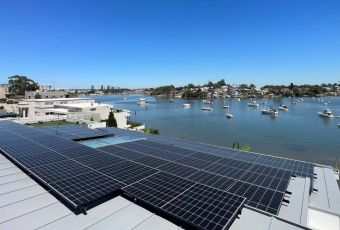
Professional solar panel installation in Sydney for homes, businesses and strata properties.
Solar Repairs
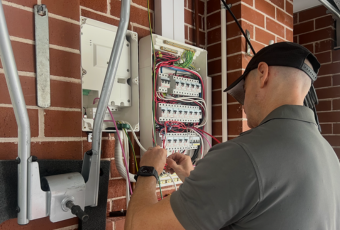
Reliable solar repairs in Sydney to fix faults, improve performance and keep your solar system working safely.

Solar Cleaning
Professional solar panel cleaning in Sydney to help improve efficiency, output and long-term system performance.
Commercial Battery Sizing FAQs
These FAQs answer common questions about commercial battery size, kWh capacity, business battery sizing and matching storage to commercial solar.
How many kWh battery does my business need?
It depends on how much electricity your business needs to shift between different periods. Interval meter data, excess solar, later-day consumption, peak demand and tariffs should all be assessed before selecting battery capacity.
What is a typical commercial battery size?
Commercial batteries vary substantially in size. Some businesses may require around 50 kWh or 100 kWh, while larger commercial and industrial properties can require hundreds of kWh or several MWh of storage.
Is a 100 kWh battery enough for a business?
It can be, but the answer depends on your site’s electricity profile. A 100 kWh battery is most useful when the business has enough available electricity to charge it and sufficient later demand to use the stored energy economically.
How do I size a commercial battery with solar?
Compare the amount and timing of excess solar generation with the amount of electricity the business consumes later. The battery should also be assessed against tariffs, peak demand and charge/discharge requirements.
Is a 200 kWh commercial battery too big?
Not necessarily. For a large warehouse, factory or industrial site, 200 kWh may be appropriate or even relatively modest. For a smaller business with limited excess solar and later demand, it could be oversized.
Should battery size match the size of my solar system?
Not directly. Solar is measured primarily in kW while battery energy capacity is measured in kWh. Battery sizing should reflect surplus generation and electricity demand rather than using a fixed ratio to solar capacity.
What’s more important for a commercial battery, kW or kWh?
Both matter. kWh determines how much electricity can be stored, while kW determines how quickly the battery can charge or discharge. Sites targeting peak demand may require particularly careful consideration of discharge power.
Does a larger commercial battery have a better payback?
Not automatically. Oversized batteries can increase capital costs without producing proportional additional savings. See Commercial Battery Payback: When Does Battery Storage Make Financial Sense? for more information.
Can a commercial battery reduce peak demand charges?
Potentially. The battery needs sufficient discharge power and usable energy to cover the relevant demand period. Read How Batteries Can Save Your Business on Peak Demand Charges for more information.
Are commercial battery incentives available in NSW?
Eligible NSW businesses may be able to access commercial battery incentives. Read NSW Commercial Battery Incentives 2026: What Sydney Businesses Need to Know for current scheme information.
Blog
Related articles
Catch up on the latest MPV Solar news and insights.



MPV Solar is committed to providing industry-leading solar energy solutions across Sydney, backed by a proven track record of successfully completing over 5,000 projects. As a family-owned business, we prioritise personalised service and truly value our clients, ensuring that each system is tailored to meet your unique energy needs.
Copyright 2026. All Rights Reserved.
Created by Codex Digital and Yakka Consulting
Get in Touch
MPV Solar
Unit 3, 43-51 College St,
Gladesville NSW 2111
info@mpvgroup.com.au
(02) 9817 0333
Monday – Friday
8:30 – 5:00pm