


 Call Us
North-facing solar panels in Sydney often generate more total electricity over a year under otherwise comparable conditions. But an east-west layout can still be a smart design when the household uses electricity earlier in the morning and later in the afternoon, or when it allows more useful solar capacity on the available roof.
Why does solar panel direction matter?
Solar output changes across the day as sunlight reaches the panels at different angles. The best roof direction is therefore about more than a single headline generation figure.
According to the Australian Government’s solar design guidance, north-facing panels generally receive strong sunlight across the day, while east-facing panels generate earlier and west-facing panels generate later.
That affects when your home can use solar electricity directly instead of buying it from the grid.
Illustrative household difference: A household that is empty on weekdays but runs cooling and cooking appliances after 3pm may value west-facing afternoon output. A household that charges an EV or heats a pool at midday may place greater value on north-facing generation. The better result depends on hourly use, total panel capacity and shading—not an orientation label alone.
What are the advantages of north-facing solar?
For many Sydney rooftops, north-facing panels provide strong generation around the middle of the day and a favourable total annual yield.
This can be particularly useful if the household is home during daytime hours or has controllable loads such as hot water, pool equipment or an EV that charges during the day.
But a north-facing roof isn’t automatically the best practical choice if it is small, heavily shaded or interrupted by skylights and roof equipment.
Why choose east-west solar panels?
An east-west layout can spread electricity generation across a wider part of the day. East-facing panels favour mornings; west-facing panels favour afternoons.
That can suit households with breakfast-time consumption, late-afternoon cooling demand or varying work-from-home schedules. It may also provide useful space for more panels where the home has two suitable roof faces.
The trade-off is that annual energy yield per installed kW can be lower than an otherwise comparable north-facing arrangement. The outcome depends on pitch, shading, system design and weather.
This is why the fairest comparison is two roof-layout proposals at the same or clearly stated panel capacity, with expected annual kWh and estimated morning, midday and afternoon generation. A larger east-west array could outperform a smaller north array in total kWh despite lower yield per installed kW.
Does east-west solar make sense with a battery?
It can. A battery changes when solar electricity is used, but it doesn’t remove the importance of a sensible panel layout.
If the aim is to charge a battery and supply the home through the evening, annual generation and available midday surplus matter. If the aim is to directly power morning and afternoon loads, a wider generation curve may be valuable.
MPV Solar’s Solar Battery Installation Sydney and daily solar output guide explain these related decisions.
Can I put panels on north, east and west roofs?
Possibly. A multi-orientation array is common on roofs with limited uninterrupted space, but the inverter design needs to account for different generation characteristics and any shading.
The best arrangement may use multiple roof sections rather than insisting on a single direction. That requires proper site measurements and design, not just a generic online calculator.
A real MPV example of using different roof sections
At Pro Wash in Bathurst, MPV Solar designed a commercial array around a curved roof, using both northern and south-east roof sections. The owners also wanted to preserve the building’s appearance. For a Sydney home, the same design questions are useful: which roof sections are usable, what affects their output and when will that electricity be needed? The Bathurst layout illustrates site-specific roof planning; a home’s north-versus-east-west comparison still needs its own modelling.
What about the Sydney summer and winter?
Day length, sun position, roof tilt and shading all affect seasonal performance. For example, a roof that’s unshaded in summer may experience longer morning or afternoon shadows in winter.
This is why comparing one exceptionally sunny day’s output can be misleading. MPV Solar assesses expected production across the year and how that production fits your household’s consumption.
How should you choose?
Ask three questions:
- How much solar can the roof reasonably generate?
- When does the home use electricity?
- Which panel arrangement gives the best overall value?
MPV Solar can compare north-facing, east-west and mixed layouts for your particular Sydney home, considering future batteries and EV charging. Explore our Residential Solar services and Residential Solar Packages.
Ask to see the proposed roof plan, shading assumptions and expected generation profile. If a salesperson gives only one annual-average kWh figure, it is reasonable to ask how that production aligns with your own electricity-usage pattern. For the separate question of expected daily totals, read How Much Should My Solar System Produce Each Day in Sydney?.
Complete Solar Solutions
Solar Installations, Repairs & Cleaning Across Sydney
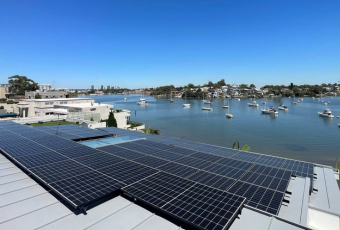
Solar Installations
Professional solar panel installation in Sydney for homes, businesses and strata properties.
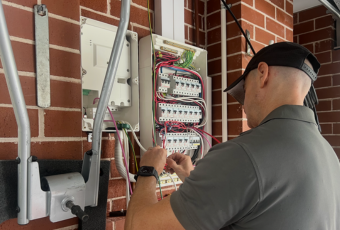
Solar Repairs
Reliable solar repairs in Sydney to fix faults, improve performance and keep your solar system working safely.
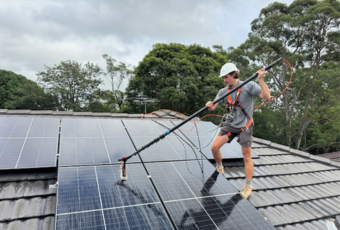
Solar Cleaning
Professional solar panel cleaning in Sydney to help improve efficiency, output and long-term system performance.
Solar Panel Direction in Sydney FAQs
These answers explain how north, east and west roof directions influence solar generation, self-consumption and system design.
Is north-facing solar best in Sydney?
It often delivers strong annual generation, but the best layout also depends on roof suitability, shading and when you use electricity.
Are east-west solar panels worth it?
They can be, particularly where morning and afternoon demand is valuable or roof geometry suits a split array.
Do west-facing panels help with afternoon air conditioning?
They can shift more generation into the afternoon, which may overlap with cooling demand.
Does east-west solar produce less electricity overall?
It may produce less per installed kW than an otherwise comparable north-facing array, but real results are site-specific.
Can I have panels facing three directions?
Potentially, if the roof and inverter design support the arrangement.
What is the best panel direction for a solar battery?
There is no universal direction. The important measures are usable total generation and when surplus energy is available for charging.
Will shading matter more than roof direction?
It can. Heavy shading may reduce output enough to change the preferred layout.



MPV Solar is committed to providing industry-leading solar energy solutions across Sydney, backed by a proven track record of successfully completing over 5,000 projects. As a family-owned business, we prioritise personalised service and truly value our clients, ensuring that each system is tailored to meet your unique energy needs.
Copyright 2026. All Rights Reserved.
Created by Codex Digital and Yakka Consulting
Get in Touch
MPV Solar
Unit 3, 43-51 College St,
Gladesville NSW 2111
info@mpvgroup.com.au
(02) 9817 0333
Monday – Friday
8:30 – 5:00pm

