


 Call Us
A commercial battery can support a business during a blackout if the system has been specifically designed and approved for backup operation. The battery must have sufficient usable capacity and power output, compatible inverters and appropriate grid-isolation, protection and transfer arrangements. An ordinary grid-connected commercial solar system, or a battery purchased only for bill savings, should not be assumed to keep equipment running when the network is down.
Why Backup Power Is a Different Commercial Battery Decision
Many businesses consider batteries because they want to store excess solar, reduce grid imports or manage demand charges. Those goals are about everyday energy economics.
Blackout protection asks something different: Which equipment must continue operating, for how long, and what level of interruption can the business tolerate?
For a small office, that might mean networking and selected lighting. For a warehouse, refrigeration, access systems and essential operational equipment may matter. For a manufacturer, the critical issue could be safe shutdown of machinery rather than running the entire facility indefinitely.
Will a Commercial Solar System Work During a Grid Outage?
Usually not by itself. Standard grid-connected solar equipment generally disconnects from the grid during an outage for safety. A facility cannot simply keep exporting electricity into a damaged public network.
Some properly designed systems can form a safe, isolated local electrical supply—sometimes described as operating in island mode. Solar can potentially contribute during the outage if the specific inverter, battery controls and protection arrangement support it.
Do not assume that a commercial solar system continues generating usable site power during blackouts just because the panels are in sunlight.
What Equipment Could a Business Keep Running?
That depends on the electrical design, the battery power rating and which circuits are selected for backup.
Possible critical loads include:
- IT, communications, security and access control;
- refrigeration and temperature-sensitive equipment;
- selected lighting, ventilation and emergency operational loads;
- pumps, controls or essential production support systems.
This list is not a promise that any particular battery can power those loads. Some equipment has high start-up currents, strict power-quality requirements or safety implications and needs its own assessment.
How Big a Commercial Battery Is Needed for Backup?
The answer has two parts: battery energy (kWh) and output power (kW).
Imagine the chosen backup circuits use an average of 30 kW and the business needs three hours of operation.
30 kW × 3 hours = 90 kWh of energy.
That is the basic load-energy requirement before allowing for inverter losses, usable battery capacity, reserve settings, degradation, temperature, changing loads and appropriate design margins. The chosen inverter must also be capable of supplying the load and any start-up peaks.
A battery advertised as 100 kWh does not automatically deliver 100 kWh to the nominated circuits under every condition. An engineering assessment must confirm usable autonomy.
For general capacity considerations, see MPV Solar’s 100 kWh Commercial Battery and Commercial Battery Size: What Does Your Business Need?. Those articles cover battery sizing broadly; this guide addresses backup-specific requirements.
Can a Battery Back Up an Entire Warehouse or Factory?
It may be technically possible for some sites, but whole-of-site backup can be expensive and complex. Large motors, refrigeration compressors, industrial equipment, high-power EV chargers and simultaneous start-up loads can quickly exceed practical battery output or energy capacity.
An alternative is to isolate essential circuits and let non-critical equipment shut down. That can extend backup runtime and reduce equipment requirements.
MPV Solar would help the facility identify where the electrical design needs specialist backup engineering rather than treating the whole site as one undifferentiated load.
Is Battery Backup the Same as a UPS?
No. An uninterruptible power supply (UPS) is designed for applications requiring very short or no interruption when supply fails. Some battery backup systems take time to detect the outage and transfer to isolated operation.
Servers, process controls, medical or other sensitive equipment may require a dedicated UPS or specially engineered solution even if the wider site has battery backup. Businesses need to specify whether a short interruption is acceptable; battery backup should not be advertised as uninterrupted power without confirming transfer performance.
Can Solar Panels Recharge a Commercial Battery During a Blackout?
Potentially, but only with compatible equipment and system controls that allow safe solar operation while isolated from the network. Solar recharge will also depend on sunshine, available PV output and the site’s critical loads.
If blackout resilience is central to the investment, the design should be tested against a long outage and poor-weather scenarios. For example, a battery that lasts through one evening may still need another energy source if the outage continues for several cloudy days.
Commercial Battery, Diesel Generator or Both?
The right answer depends on required runtime, load size, transfer time, fuel logistics, site constraints, cost and maintenance.
Batteries can respond rapidly and may be integrated with everyday solar and tariff management. Generators may offer extended operation while fuel is available, though they bring servicing, emissions, noise and refuelling considerations. Some high-resilience sites use coordinated systems with both storage and standby generation.
This is an engineering and business continuity decision, not a universal rule that one technology is always better.
Does Backup Capability Reduce Battery Payback?
It can add equipment, design or installation costs that are not required for a battery optimised purely for energy savings. However, the value of avoided downtime may be important even where conventional electricity-bill payback is modest.
Businesses should evaluate at least two kinds of value: energy savings and operational resilience. Avoid converting avoided-downtime scenarios into guaranteed savings without a documented business case.
For the energy-economics side, use MPV Solar’s Commercial Battery Payback & ROI Australia. Demand-charge reduction is covered separately in How Batteries Cut Peak Demand Charges.
What Safety and Network Approvals Are Involved?
A commercial backup installation must be safely isolated from the public grid during outage operation and comply with relevant electrical, battery and fire-safety requirements. It needs a suitable location, access for maintenance, protection arrangements, commissioning and operating instructions.
Requirements depend on the site, network and proposed equipment. Work should be handled by qualified designers and licensed electrical professionals; certain facilities may need additional fire, building or insurer review.
What Should MPV Solar Review Before Recommending Backup Storage?
The first stage should document critical equipment, power and energy demand, acceptable transfer interruption, minimum operating duration, current solar capacity, site network connection, switchboards, roof or battery location and any existing UPS or generator systems.
MPV Solar can use that information to assess whether a Commercial Battery Storage Sydney solution should include targeted backup capability.
If an outage would interrupt important business operations, talk to MPV Solar before choosing a battery size. We can review the site’s energy system and identify the backup design questions that need resolving.
Complete Solar Solutions
Solar Installations, Repairs & Cleaning Across Sydney
Solar Installations
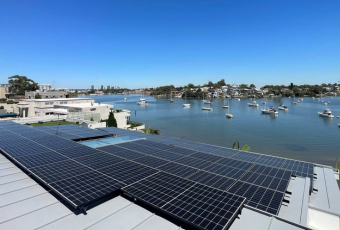
Professional solar panel installation in Sydney for homes, businesses and strata properties.
Solar Repairs
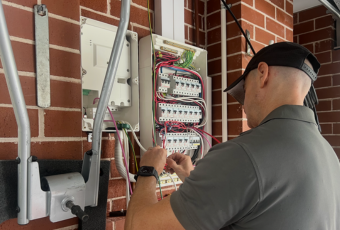
Reliable solar repairs in Sydney to fix faults, improve performance and keep your solar system working safely.
Solar Cleaning
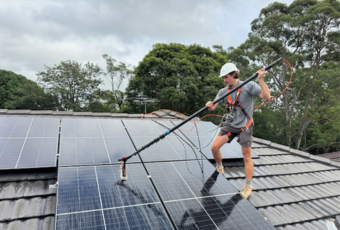
Professional solar panel cleaning in Sydney to help improve efficiency, output and long-term system performance.
Commercial Battery Backup FAQs
Considering commercial battery backup for your business? We answer common questions about backup power during blackouts, battery storage capacity, critical equipment protection, solar integration, system costs and maintaining business operations during power outages.
Can a commercial solar battery provide backup power?
Yes, if the battery, inverter, protection, isolation and transfer system are specifically designed and approved for backup operation.
Will my business’s existing solar panels work during a blackout?
Not automatically. Ordinary grid-connected solar generally disconnects in an outage. Solar operation during an outage requires suitable backup-capable equipment.
Can a battery run a whole factory during a power cut?
It may be possible, but whole-of-site backup can require very high battery power and energy. Backing up selected critical circuits is often worth assessing first.
How much commercial battery storage do I need for three hours?
Multiply the average critical-load power in kW by three hours for a starting kWh requirement, then allow for usable capacity, losses, changing loads, design margins and peak output.
Is a 100kWh battery enough for a warehouse blackout?
It depends on which warehouse circuits need backup and their total energy and power requirements. Battery capacity alone cannot answer the question.
Does a battery switch over instantly when the grid fails?
Not necessarily. Transfer behaviour is equipment-specific. Sensitive loads may still need a UPS or engineered no-break power solution.
Can a commercial battery charge from solar during an outage?
Some properly designed systems can, but not every battery/solar combination supports islanded solar recharge. It must be confirmed for the proposed configuration.
Can commercial batteries reduce demand charges and provide backup?
Potentially. The system must be sized and controlled for both objectives, including maintaining sufficient reserve for emergencies.
Is a battery better than a diesel generator for a business?
That depends on runtime, reliability objectives, site loads, fuel, maintenance, emissions and cost. Some facilities benefit from a coordinated combination.
What should a business provide for a backup battery quote?
Critical-load equipment lists, electrical drawings, recent interval data, desired backup duration, existing solar specifications and details of any UPS or standby generator are valuable inputs.



MPV Solar is committed to providing industry-leading solar energy solutions across Sydney, backed by a proven track record of successfully completing over 5,000 projects. As a family-owned business, we prioritise personalised service and truly value our clients, ensuring that each system is tailored to meet your unique energy needs.
Copyright 2026. All Rights Reserved.
Created by Codex Digital and Yakka Consulting
Get in Touch
MPV Solar
Unit 3, 43-51 College St,
Gladesville NSW 2111
info@mpvgroup.com.au
(02) 9817 0333
Monday – Friday
8:30 – 5:00pm

